
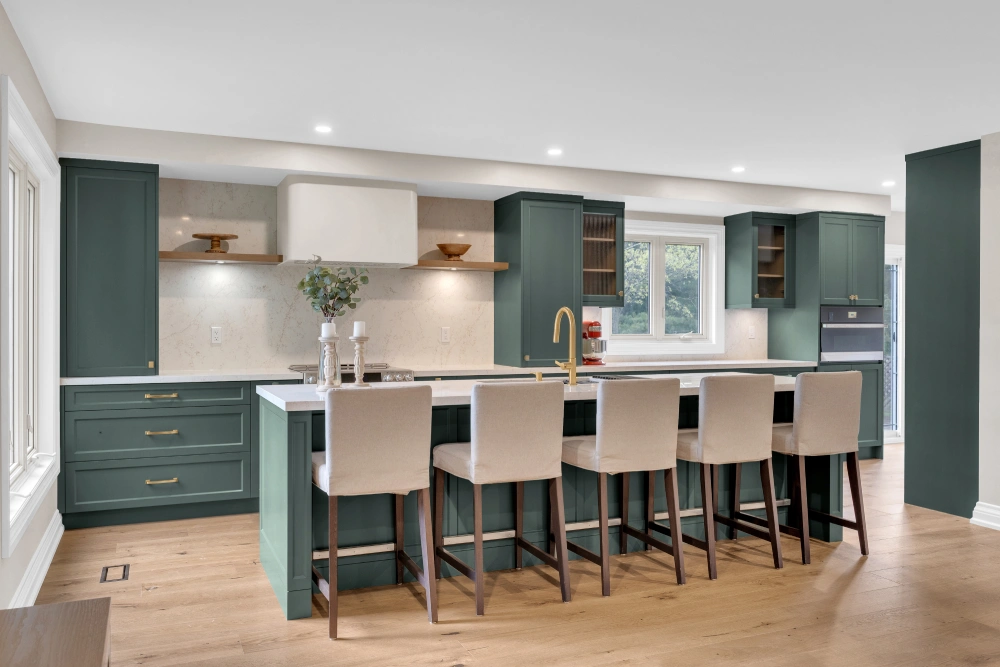
There’s a design debate unfolding in kitchens across the Greater Toronto Area, and it’s changing the way homeowners think about their most-used room. Scroll through any design feed or flip through a shelter magazine, and you’ll notice a striking trend: kitchens with vast expanses of open wall space where upper cabinets once reigned supreme.
But is this aesthetic shift practical for real life in Toronto homes? Or is the upper cabinet—that workhorse of kitchen storage—being prematurely retired?
The answer, as with most things in custom kitchen design, depends entirely on how you live.
The Case for Rethinking What’s Above
For decades, the formula was simple: lower cabinets, upper cabinets, countertop in between. This tried-and-true configuration maximized every square inch of kitchen real estate—a necessity in Toronto’s older homes, where galley kitchens and compact footprints demanded creative storage solutions.
But as open-concept living became the standard in GTA renovations and new builds alike, kitchens transformed from utilitarian workspaces into the social heart of the home. Suddenly, what your kitchen looked like mattered as much as how it functioned. And those rows of upper cabinets? They started feeling heavy. Imposing. Perhaps even a little dated.
Today’s Toronto homeowners working with custom cabinetry companies are asking a different question: What do I actually need up there?
Four Approaches to Upper Kitchen Cabinets
Whether you’re renovating a century home in High Park or building new in Oakville, understanding your options is the first step toward a kitchen that works for your lifestyle.
Traditional Upper Cabinets
The classic choice remains popular for good reason. Floor-to-ceiling cabinetry or standard upper cabinets deliver unmatched storage capacity, keeping everything from everyday dishes to seldom-used serving pieces within arm’s reach.
The advantages: Traditional uppers maximize vertical space—essential in smaller Toronto kitchens where square footage is at a premium. They conceal clutter effortlessly, maintaining that clean, edited aesthetic even when the reality behind those doors is somewhat less curated. For families juggling school lunches, dinner parties, and everything in between, this hidden storage is invaluable. Well-crafted custom cabinetry also adds architectural presence, transforming a kitchen from a simple cooking space to a designed room.
The considerations: Full walls of upper cabinets can feel visually heavy, particularly in compact spaces. In open-concept layouts where the kitchen flows into living and dining areas, they may create an abrupt division rather than the seamless transition homeowners envision.
Floating Shelves
The darling of design magazines, floating shelves offer a dramatically different aesthetic—one that’s undeniably photogenic and surprisingly practical for the right household.
The advantages: Open shelving creates visual breathing room, making kitchens feel larger and more connected to adjacent spaces. They provide optimal display opportunities for a curated collection: beautiful ceramics, heirloom cookware, artful arrangements of oils and spices. For those who appreciate their kitchen as a form of self-expression, floating shelves put personality front and centre.
The considerations: This approach works best when you can afford to lose some storage capacity—typically in kitchens blessed with a walk-in pantry, butler’s pantry, or generous lower cabinet storage. Everything on display needs to earn its place, which means either owning beautiful everyday items or committing to regular editing. Dust accumulation is real, particularly in busy cooking households.
Open Cabinets
Think of open cabinets as the middle ground—shelving with structure. These cabinet boxes without doors maintain consistent lines and elevation while offering the airy feel of open storage.
The advantages: Open cabinets integrate seamlessly alongside traditional cabinetry, allowing homeowners to mix concealed and displayed storage within a cohesive design. They work beautifully flanking a window or range hood, creating symmetry while keeping frequently used items accessible. The cabinet frame also provides a degree of visual containment that pure floating shelves lack.
The considerations: Like floating shelves, open cabinets require maintenance and curation. They suit homeowners who genuinely enjoy the ritual of keeping things organized and don’t mind the occasional dusting session.
No Upper Cabinets
The most dramatic choice—eliminating uppers entirely—makes a powerful design statement. It’s a commitment to minimalism that, when executed thoughtfully, creates genuinely breathtaking results.
The advantages: Without upper cabinets, statement pieces command attention. A sculptural canopy hood becomes the kitchen’s focal point. Backsplash materials—whether book-matched porcelain slabs, dramatic veined quartz, or artisanal tile—can run uninterrupted from counter to ceiling, creating visual impact impossible to achieve with cabinetry in the way. Windows can stretch higher, flooding the space with natural light.
The considerations: This approach demands storage solutions elsewhere. It suits homeowners with dedicated pantries, sculleries, or adjacent butler’s pantries—spaces common in custom Toronto homes but less prevalent in older properties or modest renovations. It also requires commitment to countertop discipline; without upper storage, surfaces can quickly become cluttered.
The Best of Both Worlds
Here’s what we’ve learned working with homeowners across the GTA: traditional upper cabinets are always worth designing into every kitchen. The question isn’t whether to include them, but where and how.
The most successful custom kitchens combine multiple approaches. Traditional uppers anchor the workspace near the range and prep areas, providing essential storage where you need it most. Flanking sections might feature open cabinets or glass-front doors, introducing visual interest while maintaining storage. A window wall or range wall might forgo uppers entirely, allowing a stunning hood or an unbroken expanse of backsplash to shine.
This layered approach—custom cabinetry designed to your exact specifications—delivers both function and beauty. It acknowledges that life requires storage while celebrating the kitchen as the designed space it deserves to be.
The upper cabinet isn’t disappearing from Toronto kitchens. It’s simply evolving—becoming more intentional, more varied, and more tailored to how each family actually lives. And that’s precisely what custom cabinetry should do.