
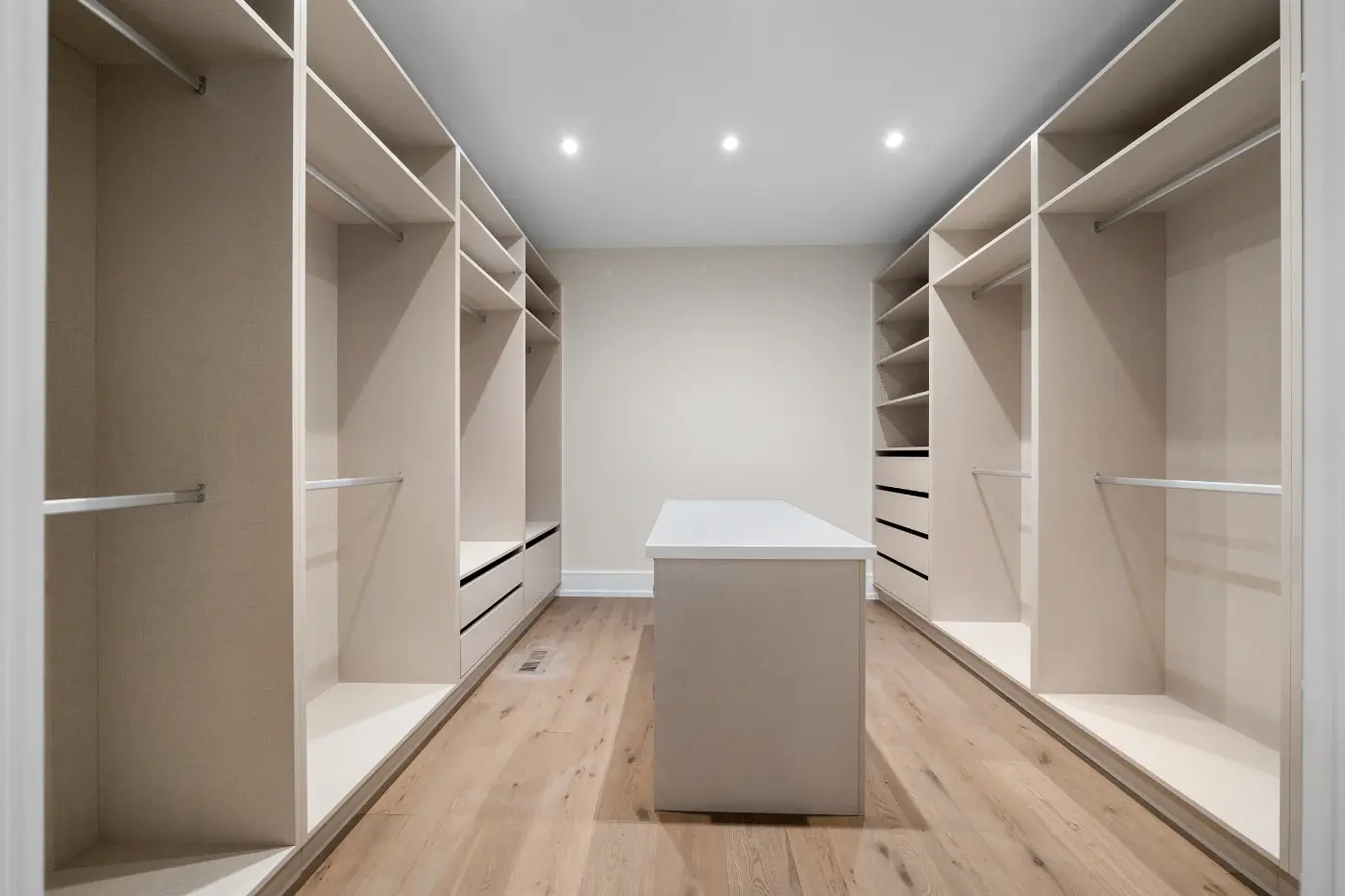
There is a moment that happens in nearly every closet consultation. A client arrives with a folder or, more often, a phone full of screenshots pulled from Instagram and Pinterest. The images are stunning. Marble-wrapped islands sitting at the centre of walk-in closets the size of a primary bedroom. Backlit display shelving for handbags. Arched doorways framing cascading gowns. And somewhere in the conversation, the question arises: Can we do something like this?
The answer, at Lucvaa Kitchens, is almost always: It depends, and let’s start with you.
Custom cabinetry in Toronto homes has evolved far beyond the kitchen. Today, custom closets, home offices, mudrooms, and built-in storage solutions are among the most meaningful investments a homeowner can make. But with the explosion of aspirational content on social media, the gap between what people want and what they genuinely need from a closet has never been wider.
Function Comes First. Always.
The most beautifully designed closet in the world fails if it doesn’t work for the person using it every morning at 7 a.m. This is the foundational principle behind every custom closet Lucvaa builds. Aesthetics matter deeply, but they are earned only after the functional brief has been fully addressed.
That belief starts at the very first consultation.
A skilled designer doesn’t simply take measurements and show material samples. They ask questions. How do you currently organize your clothing? Do you fold or hang? How many pairs of shoes do you own? Do you dress in the closet or in the bedroom? Do you share the space? These aren’t small details. They are the architecture of a well-functioning closet. According to the editors at House Beautiful, the most common regret among homeowners after a closet renovation is not investing enough in the planning phase, underestimating their own needs in favour of the look they had pinned online.
The Configuration Question: Hanging, Folded, or Drawers?
No two clients are the same, and nowhere is that more apparent than in how people prefer to store their clothing. Some wardrobes are built entirely around long single-hang sections perfect for dresses, suits, and coats. Others are better served by double-hang configurations that maximize vertical space for shirts, blazers, and folded trousers. Many clients benefit most from a combination of both, supplemented by deep drawers for knitwear, denim, or items they prefer not to hang.
Getting this balance right requires honest conversation. A client who owns thirty blazers needs something entirely different from one whose wardrobe is mostly casual wear and loungewear. The role of the designer is to listen first, then translate those needs into a layout that makes the space work harder, not just look better.
The Right Accessories Make All the Difference
Beyond hanging and storage configurations, the right hardware and accessories can transform a closet from functional into genuinely effortless. Richelieu, one of the leading suppliers of custom cabinetry hardware in North America, offers a range of closet accessories that Lucvaa frequently specifies for clients who want to go beyond the basics.
For the client who travels frequently or prepares outfits in advance, a valet rod is a quiet but powerful addition, a pull-out rod that provides a temporary hanging space for outfits being assembled or packed. Similarly, a pull-out belt rack eliminates the tangle of accessories that so often ends up in a drawer or on a hook.
For closets with high ceilings and upper-level hanging rods that are difficult to reach, the Butler electric closet rodmotorizes the entire rod, lowering it at the press of a button. A more budget-conscious alternative, the Conero pull-down closet rod, achieves a similar result through a simple mechanical mechanism that brings upper-level hanging within arm’s reach.
These are not luxury features for their own sake. They are solutions to real, daily inconveniences, and the difference between a closet that gets used well and one that gradually becomes a mess.
Materials and Light: A Practical Consideration
The choice of materials for a custom closet isn’t only an aesthetic decision; it’s an environmental one. In smaller closets or spaces with limited natural light, lighter-toned laminates and TFL (Thermally Fused Laminate) panels help the space feel open and readable. In walk-in closets with ample lighting and square footage, clients have far more freedom to explore deeper tones, wood veneers, or high-gloss finishes that make a genuine visual statement.
Lighting itself, whether natural, recessed, or integrated LED strips, should be part of the design brief from the beginning, not added as an afterthought. A beautifully built, poorly lit closet doesn’t get used to its full potential.
Open, Closed, or Glass: The Cabinet Door Dilemma
One of the most common debates in closet cabinetry is whether to use open shelving, closed cabinet doors, or a combination of the two.
Open cabinetry is ideal for tighter spaces where swinging or sliding doors would consume precious room. It also suits clients who prefer to see their entire wardrobe at a glance, without opening or closing. The trade-off is visual: open shelving demands that the contents be kept tidy, as there is nothing to hide behind.
Closed cabinet doors deliver a clean, composed look. From outside the closet, or in spaces where the closet opens into a bedroom, closed cabinetry creates a sense of calm order. The practical consideration is that, in a small footprint, multiple cabinet doors cannot be opened simultaneously, which can frustrate daily use if the layout hasn’t been carefully planned.
Glass doors offer an elegant middle ground. The closet reads as tidy and enclosed, while the contents remain visible without opening anything. Among glass options, tinted glass is increasingly popular because it softens the view, adds a sophisticated aesthetic layer, and is reasonably priced relative to the overall project. It is the option that tends to satisfy both the functional and the visual brief simultaneously.
Social Media Inspiration: A Powerful Tool with a Real Limitation
Instagram and Pinterest have genuinely changed the way homeowners approach renovation projects. They offer access to design ideas from Milan, Tokyo, New York, and São Paulo, all in a single afternoon scroll. At Lucvaa, we welcome clients who arrive with strong visual references. It tells us something important about their taste.
But the editorial team at Architectural Digest has made this point plainly in the past: inspiration boards are starting points, not blueprints. The closet in a social media post was designed for a specific person, in a specific home, with a specific budget and a specific set of priorities. It may not translate to your space, and some elements may actively work against you.
The curved design details that are trending right now, such as arched niches, rounded posts, and statement mirrors with organic silhouettes, are genuinely beautiful when they fit the space. But if including a curved arch means forgoing a full section of hanging storage, or sacrificing a drawer bank that you genuinely need, then the design is working for the photograph rather than for you. That is a trade-off worth examining honestly.
Not every trending design element adds lasting value. Some are statement pieces that photograph well but add little to the day-to-day experience of the space. The role of your designer is to help you distinguish between the two and to ensure your closet is built for the life you actually live.
Every Closet Is Personal
At the end of every consultation, one truth rises above the rest: every client is different, and every closet should reflect that.
For some people, a closet is a storage room. It needs to be efficient, organized, and easy to navigate, nothing more, nothing less. For others, the closet is something far more personal. It is the room where the day begins in earnest. The place where an outfit is chosen not just for warmth or practicality, but as a statement. A ritual. The daily act of deciding who you are going to be when you walk out the door.
That closet deserves to be designed with the same care and craft that Lucvaa brings to every custom kitchen, built-in, and cabinetry project across the Greater Toronto Area. Not for the photograph. For you.
Lucvaa Kitchens is a custom cabinetry manufacturer based in Ontario, proudly serving homeowners, designers, and builders from Niagara to Barrie. To begin your custom closet consultation,contact our team.