
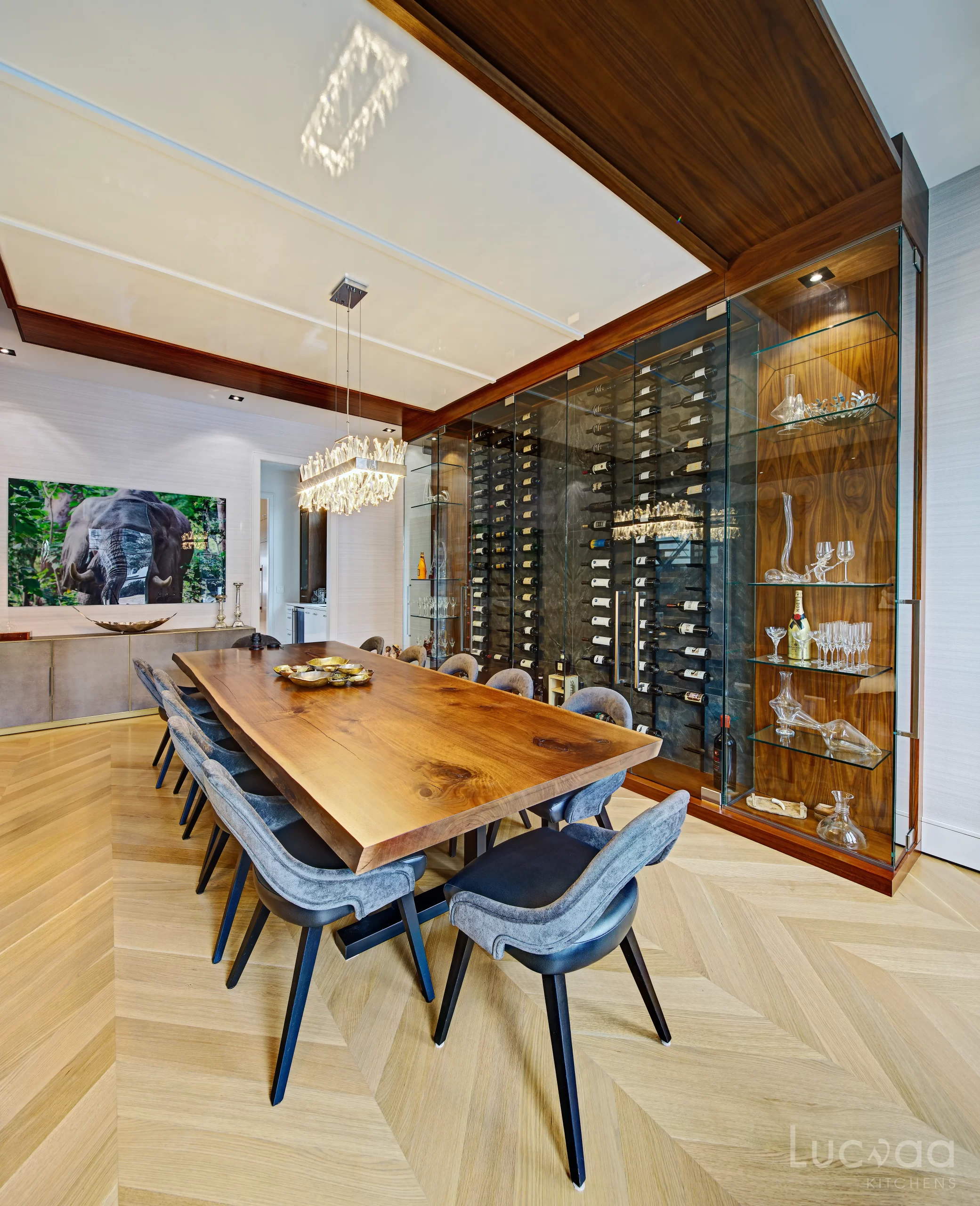
There is a particular pleasure in a well-kept wine collection. Not the cellar tucked beneath the stairs, invisible and forgotten, but wine that lives in the open — arranged with intention, accessible on a Wednesday evening, and beautiful enough to hold its own in a thoughtfully designed kitchen or dining room. For every homeowner with open-concept layouts that have collapsed the boundary between cooking, dining, and entertaining, how you store your wine has become as much a design statement as the cabinetry surrounding it.
At Lucvaa, the conversations we have with clients about wine storage rarely start with square footage. They start with the question no one else asks first: How do you actually live with wine? The answer shapes everything.
Cabinetry as Wine Architecture
Custom cabinetry has always offered the ability to make a storage system feel native to its space. Wine storage is no exception. For homeowners in the Greater Toronto Area and across North America investing in a custom kitchen, a butler’s pantry, or a home bar, built-in wine storage within cabinetry delivers a level of integration that a freestanding rack or a refrigerator drawer simply cannot replicate.
There are three primary cabinet configurations that Lucvaa crafts for wine storage, and each carries its own aesthetic logic.
The Cubby Style is perhaps the most architectural. A grid of full-depth shelves that creates individual compartments, each sized to hold a single bottle lying on its side. It reads as graphic and geometric, working beautifully in modern and transitional kitchens where precision and order are part of the visual language. A full column of cubbies integrated into a pantry wall or a kitchen island end panel becomes a quiet focal point, especially when built with an accent colour.
The X Style takes a more expressive approach. Fixed panels cross at a 45° angle within a cabinet opening, creating four angled cavities that securely cradle bottles. It has the look of something you might find in a relaxing European wine bar. In a custom home bar or a dining room hutch, the X-style insert adds character without demanding attention.
The Lattice Style is the traditionalist’s answer. A woven grid pattern, reminiscent of the classic Italian wine cellar, suits homes where the cabinetry leans toward transitional or traditional-inspired design. Paired with glass cabinet doors, a lattice-style wine section becomes as much a display as a storage system.
Truly Custom Wine Storage is available when clients want someone. Since Lucvaa customizes and constructs each cabinet to exact specifications, wine storage doesn’t have to fit a standard insert or opening. A single cabinet can serve as a standalone wine storage unit, designed as a dedicated column with its own identity, finished inside and out, and placed wherever the floor plan requires. Alternatively, the design can extend across multiple cabinet bays, forming a continuous wall of bottles that runs along an entire cabinetry section. All details addressed during the design consultation, not in the showroom. For clients with a specific vision or seeking a unique kitchen solution, this is where custom cabinetry truly shines.
Each of these configurations can be designed into virtually any cabinetry in the home: a dedicated run in the kitchen, a freestanding custom bar cabinet, a built-in sideboard in a dining room, or a pantry column tucked beside the refrigerator. They are, at their core, a matter of proportion and placement, and that is where thoughtful design matters most.
The Case for Wine Pegs: Minimalism With Impact
Not every client wants their wine integrated into a closed cabinet. Many of their collections are visible and wall-mounted, displayed as in a gallery.
This is where the conversation turns to wine pegs, and the options have never been more refined.
Richelieu Hardware’s Vitigno 1-2-3 anodized aluminum wine pegs are designed to support each bottle at both the neck and the base, holding it horizontally and parallel to the wall. The configuration is fully customizable, with bottles arranged one-deep, two-deep, or three-deep, depending on the depth of the collection and the drama the client wants to create. The result is a wine wall that reads more like a sculpture than a storage solution. Available in brushed aluminum, matte black, and brushed gold, the finish can be selected to complement cabinet hardware or the kitchen’s broader metal palette.
For a more spare, architectural expression, Leggero wine pegs take the concept even further toward minimalism. Slim dual-rod pegs hold each bottle perpendicular to the wall, cork facing outward. On a feature wall between the kitchen and the dining area, or running floor-to-ceiling in a dedicated wine room, Leggero pegs dissolve into the background, letting the wine itself become the visual element.
Both systems use integrated silicone rings to hold bottles securely, preventing vibration or slippage, so a wine wall of any scale can be built incrementally, growing with the collection. As a fraction of the cost of a full cedar-lined wine cellar, they are among the most impactful premium upgrades available in the custom cabinetry space. A broader overview of Richelieu’s complete wine storage solutions is worth exploring for clients planning more extensive installations.
The Right Answer Depends on You
There is no universal design for wine storage in a custom home. A collector with several hundred bottles and a dedicated tasting room has different needs than a couple who keep a dozen bottles in the kitchen for casual entertaining. Both deserve a solution that feels considered, with neither an afterthought nor an overreach.
Lucvaa’s approach has always been to let the client’s life lead the design. That might mean a full column of cubby-style cabinetry flanking a custom refrigerator panel in a North York kitchen renovation. It might mean a set of Leggero wine pegs mounted to the back wall of a dining room built-in in a Rosedale home. It might mean an X-style insert in a bar cabinet paired with Vitigno pegs on an adjacent wall: a hybrid solution that offers both the warmth of wood cabinetry and the sculptural quality of exposed bottles.
What it will never mean is a one-size-fits-all answer handed down without a conversation.
That conversation is where great custom cabinetry begins.
Lucvaa designs and manufactures custom cabinetry for kitchens, closets, and home interiors across the Greater Toronto Area. To begin a consultation, visit lucvaa.com.