
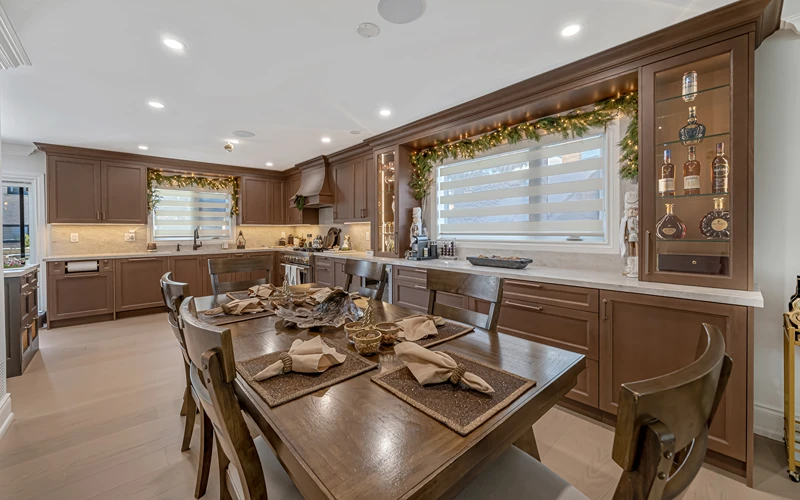
There’s a moment that happens in almost every design consultation lately. A homeowner walks in with a folder full of pale, airy kitchens, all bright white and cool grey, and somewhere in the conversation they pause, run a hand across a sample, and say something like, “Actually, I think I want it to feel warmer.” Nine times out of ten, the sample they’re touching is walnut.
After a few years in the wings, walnut is back. And in kitchens, closets, and custom cabinetry across the GTA, it’s arriving with a quiet confidence that feels less like a passing trend and more like a homecoming.
The short version: Walnut was the defining cabinetry wood from roughly 2014 to 2018, then ceded the spotlight to flat matte laminates and, later, the Scandinavian wave of white oak. Now it’s returning, prized for its rich chocolate tones, smooth grain, and the warmth it brings to the cool, minimalist kitchens that have dominated Toronto for the better part of a decade. Walnut veneer, in both flat-cut and reconstituted forms, offers something white oak and maple simply can’t: depth.
Why is walnut making a comeback in Toronto kitchens?
Design moves in cycles, and Toronto has ridden the full arc. Walnut had its first big moment last decade, all those handsome, grounded kitchens built around dark, characterful cabinetry. Then the pendulum swung hard toward European minimalism: thermally fused laminates in soft greys and woodgrains, handleless slab doors, the whole pared-back, budget-friendly look that filled condos from Liberty Village to the edges of Yorkville. After that came white oak, riding the Scandinavian wave, light and rift-cut and endlessly photographed.
Here’s the thing about a decade of cool: eventually a room starts to feel a little clinical. Homeowners in Rosedale, Forest Hill, and Lawrence Park are circling back to materials with a pulse, and walnut answers the call. It does what the pale woods can’t. It adds gravity. It makes a big, bright, open-concept kitchen feel like somewhere you’d actually want to linger over a glass of wine.
What’s different this time is how it’s being used. Walnut isn’t the whole kitchen anymore. It’s the accent, the island, the run of base cabinets that anchors a sea of white. Which is exactly where it earns its keep.
What makes walnut veneer different from white oak and maple?
If you’ve only ever compared these woods on a sample chip, the differences can feel subtle. In a full kitchen, they’re night and day.
Walnut runs deep: chocolate browns with cocoa, purple, and grey undertones, often shifting within a single board. Its grain is medium and smooth, less busy than oak, with a soft, flowing movement rather than aggressive lines. Curiously, walnut lightens with age and sunlight, mellowing toward a warm honey amber over the years, where most woods darken.
White oak is the cool cousin. Lighter, golden to greyish, with a prominent open grain. Rift-cut white oak in particular gives those clean, straight, linear lines that pair so naturally with a modern, minimalist aesthetic. It’s lovely, but it reads contemporary and a touch reserved.
Maple is the quiet one. Pale, creamy, and tight-grained almost to the point of having no figure at all. It’s smooth and hard and takes paint beautifully, which is why you see it so often in bright, painted kitchens. Stained, though, it tends to blotch, and it never offers walnut’s richness.
| Wood | Colour & tone | Grain character | Where it shines |
| Walnut | Deep chocolate browns with cocoa, purple, and grey undertones; lightens to honey amber with age | Medium, smooth, softly flowing rather than busy | Warm islands, base cabinets, statement millwork |
| White oak | Golden to greyish; cooler and more reserved | Prominent open grain; rift-cut reads clean and linear | Light, contemporary, Scandinavian-leaning kitchens |
| Maple | Pale and creamy; can blotch when stained | Very tight and subtle, almost no figure | Bright, painted cabinetry and minimalist looks |
Then there’s the question of how the veneer is cut.
Flat-cut walnut veneer, sometimes called plain-sliced, is the classic. Slicing the log this way produces that signature cathedral grain, those soulful arches and loops, with real variation from panel to panel. No two sheets are identical, and when sequence-matched across a run of cabinets, the effect is genuinely beautiful, like the wood is telling one continuous story across the room.
Reconstituted (recon) walnut veneer is the engineered option. Fast-growing logs are dyed and pressed into blocks, then sliced to produce a remarkably consistent, repeatable grain with no knots or surprises. For a large kitchen where you want predictable, uniform colour across a dozen panels, or for clients who prefer a cleaner, more contemporary read, recon is often the smarter call. It’s also a more efficient use of the raw material.
Neither is “better.” Flat-cut has soul and movement; recon has consistency and calm. The right answer depends entirely on the room, the budget, and the look you’re after, which is a conversation worth having before a single panel gets cut.
How does Lucvaa work with walnut?
Walnut rewards precision and punishes shortcuts, so the process matters. When a sequence-matched veneer order arrives at our Toronto shop, the BIESSE Winstore panel storage system keeps every sheet tracked and in order, so the grain sequence we planned on paper is the grain sequence that ends up on your wall. From there, our BIESSE Rover CNC machines cut each part to identical tolerances, because with walnut’s flowing grain, even a millimetre out of true will show.
The finish is where walnut truly comes alive. A pass through the VIET Opera automated sander brings the surface to a uniform smoothness no hand-sanding can match, and our Venjakob Perfect automated spray line, paired with the Vario Time drying system, lays down a clean, even coat that lets those chocolate tones glow rather than muddy. When a project is ready to ship across the GTA, our Packsize machine builds packaging sized to each individual piece, so it arrives exactly as it left the floor.
What does walnut look like in a real Toronto home?
You can talk about wood all day. It’s the finished rooms that make the case.
At Silverthorne, we used walnut veneer in a natural stain on the base cabinets, set against crisp white uppers. It’s the two-tone move done right: the walnut grounds the room, the white keeps it bright, and the whole thing reads classic rather than trendy.
South Hill takes a similar tack in a naturally light-filled space. Walnut veneer bases pair with white shaker cabinets, and the contrast does all the work, warmth at the bottom, air at the top, and sunlight bouncing off both.
And at Mount Hope, we went all in with solid walnut doors in our Stratford profile. No veneer here, just the real thing, showing off walnut at its most architectural and substantial.
Frequently asked questions
Is walnut a good choice for kitchen cabinets?
Yes. Walnut is a durable hardwood that wears beautifully, and its rich tone disguises everyday life better than pale woods. It’s especially effective as an accent or island wood paired with painted cabinetry.
Is walnut more expensive than white oak or maple?
Generally, yes. Walnut sits at the premium end, particularly in solid form or as flat-cut veneer. Reconstituted veneer can bring the cost down while keeping the look.
Does walnut darken over time?
The opposite, actually. Unlike most hardwoods, walnut lightens with exposure to light, mellowing to a warm amber over the years.
Flat-cut or recon walnut: which should I choose?
Flat-cut for natural variation and character; recon for consistent colour across a large run. It comes down to the look you want and the scale of the project.
Can I use walnut for closets and built-ins, not just kitchens?
Absolutely. Walnut is stunning in custom closets, home libraries, and built-in millwork throughout the home, where its warmth turns everyday storage into a feature.
Bring walnut into your home
Thinking about working walnut into your own kitchen, closet, or built-in? Every home and every budget is different, and the best walnut decisions get made in conversation, not off a price list. Book a consultation with Lucvaa, Toronto’s custom cabinetry maker, and let’s figure out what’s right for your space.