
There is a particular hush inside a flagship boutique in Yorkville. The lighting is low and warm where it needs to be, sharp and clean where it doesn’t. A single pair of shoes sits on an angled brass rail, lifted from the shelf like a small museum object. Three handbags share a quiet stretch of wall, each given room to breathe. Behind glass, a tray of rings catches the light without trying. Everything has been placed.
Now picture the closet you walked out of this morning.
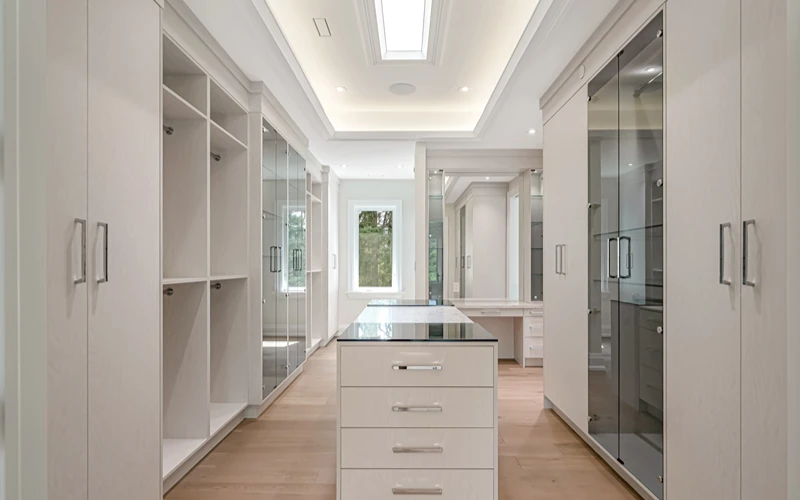
For decades, the walk-in closet was treated as an architectural afterthought, a room whose job was to hold what wouldn’t fit anywhere else. That has changed. Across the world, a new generation of custom cabinetry clients is asking for something different. They want the closet to behave less like storage and more like a space they actually want to spend time in. They want, in other words, the boutique. And it has very little to do with the size of the budget.
The closet as a curated room
The closet most of us grew up with treats every garment as more or less the same problem. A pole, a shelf, a row of hooks. The most-worn piece and the never-worn piece occupy the same visual real estate. Everything is technically accessible, which is another way of saying that nothing is featured.
A retail-inspired walk-in starts from the opposite premise. It assumes that what you own deserves to be seen. Hanging is broken up by category and length, so a row of suits doesn’t quietly compress the space for a row of dresses. Folded knitwear lives in shallow drawers, three pieces deep, so the sweater at the bottom isn’t the one you forgot you owned. Shoes are angled outward instead of stacked. A handbag gets its own shelf, sometimes with a soft strip of light tucked underneath. There is a place to sit down, because zipping a boot is harder standing up.
At Lucvaa, that conversation starts long before anyone draws a line. The designers ask what is hanging in the current closet and what gets worn. They ask how often the client travels, whether luggage needs a home, and whether mornings are slow and ritualistic or fast and harried. The details are unglamorous, but they are what separate a closet that photographs well from one that lives well. The aesthetic follows the function, not the other way around.
What the boutiques know about hardware
What makes a luxury retail space feel luxurious is rarely the wood. It is the small mechanical decisions most shoppers never consciously register. Closets borrow the same vocabulary.
A set of angled shoe rails does for a row of pumps what a curator does for a wall of paintings. Each pair comes into conversation with the others instead of being buried under them, and the vertical space above, ordinarily lost, becomes useful again. The closet stops looking like inventory and starts looking like a wardrobe.
Electric closet rods used to feel like a curiosity, a detail you saw in a magazine spread on a New York penthouse. They have grown up. In a Toronto walk-in with proper ceiling height, the upper hanging rod lowers at the touch of a button, bringing the wardrobe within reach. It is the difference between using the top of the closet and pretending it isn’t there.
Then there is the jewelry. The newer answer, borrowed almost entirely from the jewellers themselves, is a shallow drawer fitted with felt-lined inserts. Every ring, every earring, every necklace lay flat under a soft, even surface. The morning decision happens in seconds because the visual noise has been removed.
These are working accessories, not flourishes. A modest walk-in with one well-considered jewelry drawer and a single bank of angled shoe rails will outperform a sprawling closet that lacks them, every time.
The material story
In retail interiors, materials set the room’s temperature. They tell the customer, before any garment is touched, what kind of experience it will be.
Tafisa’s Sommet Series of decorative panels, produced in Canada, has become a quiet workhorse for closet interiors that need to feel grown-up. The grain is two-sided embossed and in register, the technical way of saying the texture you see matches the texture your fingers feel. The illusion of timber is complete, without the warping, the maintenance, or the cost.
For closets that want to feel like a brighter, more contemporary boutique, Tafisa’s Lummia Technology offers a lacquered finish in either high gloss or perfect matt. High gloss is particularly useful in interior closets without a window of their own, because it reflects the light there and makes the room feel twice its size. Matt does the opposite, swallowing the light into a softer surface that pairs beautifully with brass and bronze.
Italian panels from CLEAF bring a different accent. The textures are synchronized, the palette is contemporary, the European boutique sensibility unmistakable the moment a door opens. The most interesting Lucvaa closets often mix the two: a Tafisa woodgrain on the hanging side and a CLEAF texture on the island, telling a small, layered material story rather than a single flat note.
The unglamorous part, which is the point
A luxury retail space looks effortless because everything is meticulously finished, with precise angles, perfect edges, and panels that align flawlessly. Closet work is no different; angled shoe rails and high-gloss panels require precise cuts that human hands can’t consistently achieve across multiple shelves. Components are cut on CNC machines, and surfaces are carefully sanded, finished, and dried using automated systems. Even the cardboard packaging is custom-cut to prevent damage during delivery. This behind-the-scenes process ensures the closet maintains its quality and appearance over time.
What luxury actually means
A luxury walk-in is not, ultimately, a question of size. It is a question of whether the design respects the way the person inside it actually lives.
A small walk-in, fitted with the right hardware and laid out with intention, will quietly outperform a closet three times its size that was treated as an afterthought. The principles travel. They work in a Yorkville condominium as well as in a Hoggs Hollow primary suite. They work for the client whose budget is the budget, and for the client whose budget is open. What they require is a designer willing to listen first and a maker capable of delivering on the design’s promise.
Every closet, every home, every wardrobe is different. The best ones are designed for the person who lives in them, not for those who live around them. That is what the boutiques figured out a long time ago. The closet has finally caught up.
The room you visit first thing in the morning and last thing at night ought to feel like it was made for you. It can be.
Considering a custom walk-in closet in Toronto or the Greater Toronto Area? Begin the conversation at lucvaa.com.