
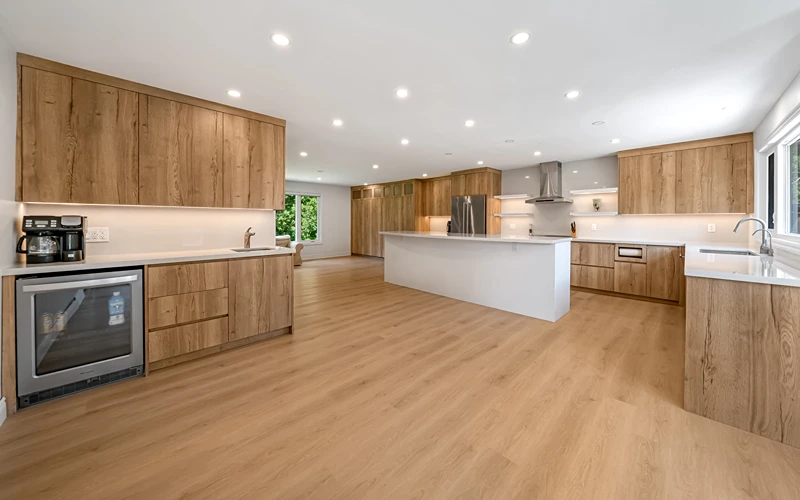
Two materials, one common mix-up, and a simple way to make sure you are not paying for durability your home will never use.
The short version: TFL (the material many still call melamine) and HPL (what almost everyone calls “laminate”) are not the same thing, and they are not interchangeable. For the vast majority of residential cabinetry and millwork in Toronto homes, TFL is durable, beautiful, and a fraction of the cost. HPL earns its place on countertops and in high-traffic, hard-use settings. Knowing which is which can save you real money without giving up a thing on quality.
There’s a conversation that happens more often than it should, usually somewhere between the design phase and the quote. A homeowner is told their new kitchen or closet will be built from “laminate,” and they immediately picture something cheap and dated. Or a project gets specified for high-pressure laminate from top to bottom, the price climbs, and nobody stops to ask whether that was the right call in the first place.
The truth is that two materials sit behind most of the custom cabinetry being built across the GTA right now. They sound almost identical. And a surprising number of people, including some in the trade, mix them up. So let’s clear it up, because the difference between TFL and HPL is not academic. It shows up on your invoice.
So what is TFL, really?
TFL stands for thermally fused laminate. For years, it went by the name melamine, and plenty of people still call it that out of habit. Here’s what’s actually happening: a decorative paper, printed to look like wood, stone, or a solid colour, is saturated with melamine resin and fused directly onto a panel of particleboard or MDF under heat and pressure. The surface and the board become a single piece. There’s no separate glue layer waiting to fail, because there’s no separate gluing step.
What you get is a panel that’s hard, scratch-resistant, and remarkably consistent. The range is the part that surprises people. Modern TFL comes in deep woodgrains with textures embossed to match the printed grain, soft matte and high-gloss solids, stones, and concrete looks that are genuinely hard to read as anything but the real thing across a room. Canadian panel makers like Tafisa have pushed this far enough that a TFL island can pass for quarter-sawn oak right up until you’re close enough to touch it.
For cabinet boxes, doors, closet interiors, shelving, and most of the surfaces in a home, TFL is quietly doing the heavy lifting in custom cabinetry today. And it should be.
And HPL? Why does everyone call it “laminate”?
HPL is a high-pressure laminate, and it’s the one most people mean when they say “laminate.” It’s built differently. Several layers of kraft paper are stacked beneath a decorative sheet; the whole thing is saturated with resin and cured under far higher pressure than TFL, resulting in a hard, finished sheet that exists on its own. That sheet is then bonded to a substrate in a second, separate operation.
Those extra layers and that second step are exactly why HPL is tougher, and exactly why it costs more. It shrugs off impact and abrasion better than almost any surface in its price class, which is why you find it on countertops, worksurfaces, and the casework in places that take a beating: schools, clinics, offices, busy retail floors. If a surface is going to be scrubbed daily, leaned on by strangers, and knocked by a rolling cart, HPL is built for exactly that life.
When does HPL actually make sense at home?
In a house, the honest answer is: sometimes, in specific places. A hardworking countertop is a natural fit. So is a mudroom bench the whole family drops onto in wet boots, a laundry folding surface, or a built-in desk that’s going to see laptops, coffee rings, and elbows for a decade? Anywhere a horizontal surface takes real daily punishment, HPL is a smart, durable choice and a great substitute for pricier solid surfaces.
Where it gets expensive and a little bit silly is when an entire residential project gets specified in HPL out of habit. It happens more than you’d think. Some professionals carry their commercial instincts into the home, where “more durable” feels like the safe default. But a cabinet door in a private home does not live the life of a cabinet door in a busy clinic. It isn’t slammed by a hundred different hands a day. It’s opened by the same few people who, on the whole, treat their own things with a bit of care. Spec’ing HPL for that door means paying commercial prices to solve a problem the home doesn’t have.
So neither one is bulletproof?
Correct, and this part matters. HPL is durable but not impervious. It can still scratch and chip along an edge, and is not heatproof, so a pan straight off the stove will mark it. TFL is durable but not impervious either. Abuse an edge, and it can chip; leave standing water against an unsealed seam long enough, and the underlying substrate can react.
Both are excellent engineered surfaces. Neither is indestructible. The goal was never to find one magic material that survives anything. It’s to match the surface to how the space is actually used, then build it properly so the edges and seams hold up.
So which one belongs in your home?
For the vast majority of residential cabinetry and millwork, TFL is just as good as HPL and costs a fraction of the price. That’s the headline. In a Toronto home, where cabinetry is treated with everyday care rather than institutional abuse, a well-built TFL kitchen, closet, or wall of built-ins will look beautiful and hold up for years. When a particular surface genuinely needs more, a heavy-use countertop or a hardworking bench, HPL steps in precisely where it should.
The whole trick is knowing the difference and applying each where it earns its keep. That’s the part a good designer should be doing for you, rather than defaulting to the most expensive option and calling it the safe one.
Frequently asked questions
Is TFL the same as melamine? Essentially, yes. Melamine is the older name for what the industry now calls TFL, or thermally fused laminate. Melamine resin is still part of how it’s made, which is where the old name came from.
Is TFL cheaper than HPL because it’s lower quality? No. TFL costs less mainly because it’s made in a single fused step, whereas HPL is a standalone sheet that must be manufactured and then bonded on. Given how cabinetry is used in a home, TFL’s durability is more than enough.
Can you use HPL on cabinet doors? You can, and once in a while, it’s the right call for a very high-use space. For a typical residential kitchen or closet, though, it usually adds cost without adding any value you’ll ever actually notice.
Which holds up better to water, TFL or HPL? Both resist surface moisture well. The vulnerability for either one is at the edges and seams, where water can reach the substrate: good edge banding and proper construction matter far more than the surface material itself.
Can I mix TFL and HPL in the same project? Absolutely, and that’s often the smartest approach. TFL for the cabinetry and interiors, HPL where a surface takes real punishment. You get the look you want and the toughness where it counts, without overpaying across the board.
Let’s match the material to the space.
Choosing cabinetry materials shouldn’t feel like decoding an acronym. At Lucvaa, our designers help homeowners across Toronto and the GTA match the right surface to the right place, so your kitchen, closet, or custom millwork looks the way you pictured it and performs the way you need it to, without paying for durability you’ll never use. If you’re planning a project and want a straight answer on what belongs where, book a consultation at lucvaa.com.