
An editorial on when slim aluminum profiles elevate bespoke kitchens, closets, and millwork, and when they don’t.
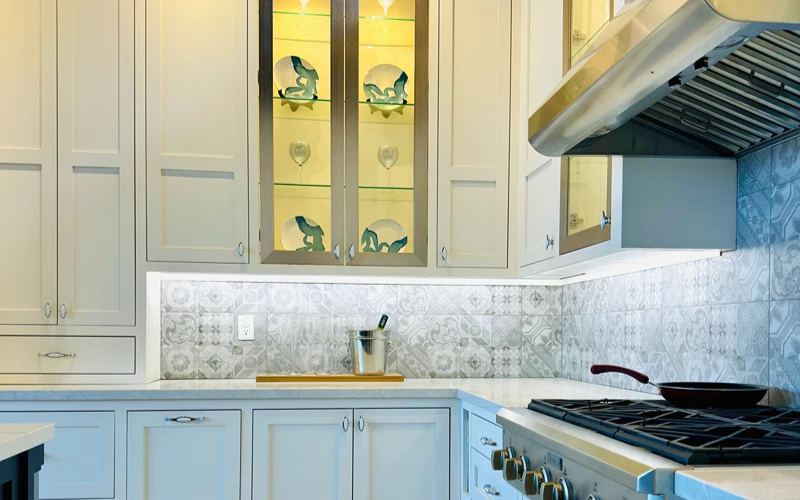
In the finest Toronto kitchens, there comes a moment when the eye ceases its search. The room has been considered down to the last reveal, the last shadow line, the last brushed metal pull. Something is different here, something quiet. Often, it is the doors. Not solid slabs of timber or sprayed lacquer, but slim aluminum frames cradling glass, fluted reeded panels, or a whisper of woven rattan. They catch the light differently. They feel architectural rather than decorative, and they signal, without shouting, that this is bespoke work.
Aluminum-framed doors are not a new idea, but their thoughtful application in residential custom cabinetry has become one of the defining gestures of contemporary Toronto interiors. Used well, they elevate a kitchen, a wardrobe, an entertainment wall, or a butler’s pantry. Used indiscriminately, they read as cold or clinical. Knowing the difference is what separates a catalogue install from a project worth photographing.
Why Aluminum, Why Now
The appeal begins with the profile itself. Aluminum frames are slimmer than wood mullions, often a fraction of the width, which means more glass, more interior visibility, and a lighter visual footprint in a Toronto condo where every centimetre of perceived space matters; that slenderness reads as generosity. In a Forest Hill kitchen with twelve-foot ceilings, the same profile reads as restraint, a deliberate counterpoint to the room’s volume.
Material choice matters too. Anodized finishes resist scratching and fingerprints in ways that painted MDF cannot. Bronze, champagne, matte black, brushed nickel, and warm gold tones layer beautifully with the brass, walnut, and travertine that define the moment in GTA design. The frame becomes jewelry for the cabinetry, a deliberate accent rather than a structural afterthought.
At Lucvaa, the suppliers behind these systems are chosen with the same rigour as the rest of the build. Interfonction, distributed through Richelieu, offers an extensive catalogue of aluminum profiles, hinges, and glass options engineered for soft-close performance and long-term alignment. ElaPorte, a Canadian manufacturer, fabricates custom aluminum-framed doors to specification, meaning a Toronto client is never forced to compromise on dimensions to fit a standard module. The doors are sized for the opening, not the other way around.
Where Aluminum Earns Its Place
The most successful applications share a common thread: the door is doing something a solid panel could not. Upper kitchen cabinets with reeded or fluted glass diffuse light into a working room without exposing every cereal box and mismatched mug. Open framed doors with clear glass become a quiet display, lit from within, for ceramics or curated glassware. In a butler’s pantry or wine cabinet, smoked or bronze-tinted glass conceals enough to feel polished while still hinting at what is held inside.
Walk-in closets benefit just as much. A bank of full-height wardrobe doors in slim aluminum and frosted glass softens an entire dressing room. The wardrobe stops feeling like furniture and starts feeling like architecture. Behind them, custom closet interiors, drawer fronts in matte lacquer, leather-lined jewelry trays, and integrated lighting remain protected from dust without disappearing entirely from view.
Home offices and libraries are another natural fit. A wall of bookcases capped with aluminum and glass at the upper run lets a collection breathe while protecting first editions from the inevitable dryness of the Toronto winter. Entertainment units achieve a cohesive rhythm when speaker fabric or smoked glass is set within a consistent aluminum profile across the wall.
Where It Does Not Belong
Honesty matters here. Aluminum-framed doors are not the right answer for every project, every room, or every client. A traditional Rosedale kitchen with inset shaker doors, beaded face frames, and a soapstone hearth would be poorly served by a slim metal profile that fights the millwork rather than supporting it. A heritage Cabbagetown home with original mouldings often calls for painted wood and applied panel detail. A child’s bedroom or a heavily used mudroom may benefit far more from solid, kick-proof construction than from glass in a frame.
This is the conversation that begins every Lucvaa Kitchens project. Cabinetry should serve the architecture and the way a family actually lives. When aluminum-framed doors are right, they are unmistakable. When they are wrong, the room knows it.
A Considered Conclusion
Aluminum-framed doors are a contemporary upgrade, not a default specification. They reward thoughtful design and demand precise execution, which is exactly why they have become a signature element in the most considered Toronto custom kitchens, closets, and millwork projects. Every home is different. Every client is different. Every budget is different. The right answer for a downtown penthouse is not the right answer for a century home in High Park, and a good cabinetmaker should be willing to say so before a single drawing is finalized.
The conversation starts the same way every time at Lucvaa. What does the room want to be, what does the family need it to do, and which materials, hardware, and doors will quietly deliver both? Sometimes the answer is a slim aluminum frame. Sometimes it is not. That choice, made with care, is what bespoke means.