
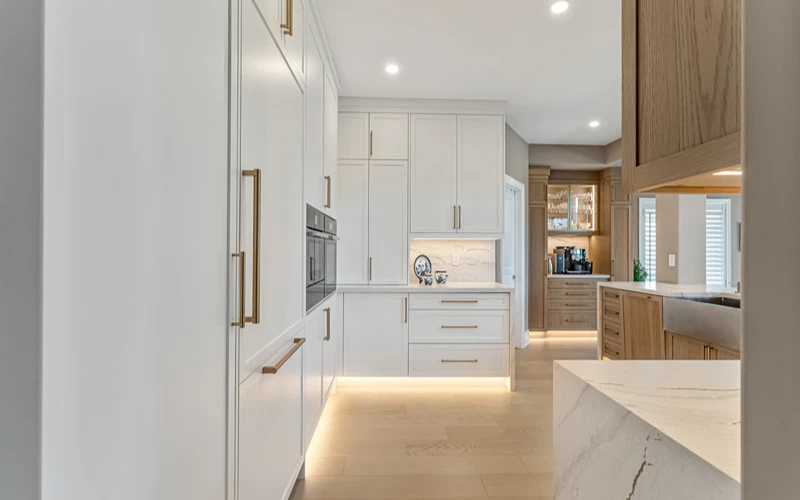
Why the smartest custom cabinetry decisions are the ones you make for the life you’re actually living.
There’s a particular kind of Toronto kitchen that exists mostly on paper. You’ve probably stood in one. It’s the kitchen a homeowner installs six months before listing, the one a well-meaning agent calls the kind that “shows well.” Crisp white doors. A quartz island. Nothing anyone could object to, and nothing anyone will remember. The owners spend a small fortune, take the listing photos, and move out before they ever learn where the late-afternoon light falls on the counter.
Then there’s the other version. A couple in Lawrence Park, the kids long gone, decide it’s finally time to redo the house so they can stay in it for good. Everything gets planned around grab bars, lower counters, and a future they’re quietly bracing for. Sensible. Considerate. And built entirely around a someday rather than a right now.
Both renovations have something strange in common. In both cases, the person paying for the work is the one least likely to enjoy it.
The short version: Most home renovations get designed for someone else, a future buyer or an older version of yourself, and the people who pay for them rarely get to enjoy them. The better approach is to renovate for how you actually live today. A well-designed custom kitchen, a proper walk-in closet, a wall of built-ins that fits your real life: these reward you every single day. And good craftsmanship holds its value no matter who eventually lives there.
Why do most people renovate at the wrong time?
Ask around in Forest Hill, Rosedale, or High Park, and you’ll hear two versions of the same story. People renovate to sell, or they renovate never to sell again. Both push the payoff somewhere out of reach.
The seller is the clearer case. You sink real money into a new kitchen, you stage it, you photograph it, and then you hand the keys to a stranger. You never cook the Sunday roast in it. You never figure out which drawer your hands reach for without thinking. You bought the upgrade and gave away the experience.
The age-in-place renovation is gentler and a little sadder. The intentions are good, but the whole design is oriented toward decline rather than the years of good living that come first. You can plan for the future without surrendering the present to it. There’s usually a long, lovely stretch in between, and it deserves a kitchen and a closet built for it.
What actually happens to a renovation designed for resale?
Here’s the irony nobody mentions at the listing appointment. The buyer often tears it out.
Resale renovations deliberately chase the lowest common denominator—neutral palette, broad-appeal finishes, nothing too specific to anyone. The logic sounds reasonable: don’t scare anyone off. But a kitchen built to appeal to everyone tends to mean nothing to anyone, including the person who paid for it. And buyers don’t actually want neutral. They want to make the place theirs.
So the white box kitchen that “shows well” goes into a demolition bin a year or two after the sale, and the new owners build the kitchen they actually wanted. Money spent, joy skipped, and a dumpster in the driveway. It’s a strange way to treat a house, and an even stranger way to treat your own time.
What does it look like to renovate for yourself?
It looks like cabinetry shaped around your habits instead of a hypothetical stranger’s.
The home cook who lives in deep pot drawers gets deep pot drawers, not a wall of upper cabinets they have to climb for. The person who bakes wants a cool stone landing and a spot for the stand mixer that doesn’t involve lifting it onto the counter every single time. The reader in Cabbagetown who falls asleep with a book wants a proper library wall in the bedroom, with the right depth for hardcovers and a ledge for the lamp.
Closets are where this gets most personal. A custom walk-in closet designed around how you actually dress, your shoes, your watches, the way you like your shirts hung, turns a daily chore into something close to a pleasure. A freestanding vanity in the powder room because you love the look of it, full stop. Custom built-ins in the family room that hide clutter and frame what you want to see. None of this is about impressing a buyer. It’s about the small, repeated satisfaction of a home that fits.
That’s the whole case for custom cabinetry in Toronto, really. Stock cabinetry asks you to live around its limits. Bespoke work in a custom kitchen, closet, or built-in is designed around yours.
Does renovating for yourself hurt resale value?
This is the part people have backwards. It doesn’t.
Quality reads as quality. A buyer who walks into a beautifully made custom kitchen or a thoughtfully fitted walk-in closet recognizes the care immediately, even when their taste runs in a different direction. What actually drags down value is cheap, dated, builder-grade work, not personality. Good craftsmanship is legible to everyone.
So you don’t have to choose between living well and protecting your investment. Build it properly, in materials you love, around the way you live, and it holds its value while you enjoy it. The enjoyment is the part you get to keep. Everything else is just resale.
Where does custom cabinetry fit into all of this?
This is how a design-first studio thinks about a project: it starts with you, not a demographic. The conversation is about how you cook, how you store, how you move through your rooms, what’s on your wishlist and what your budget actually allows. Some clients want a showpiece kitchen on the main floor of a Hoggs Hollow home. Some want one quietly perfect walk-in closet. Both are right, because both are built for the people living there.
Every home in the GTA is different, and so is every person in it. The best renovation isn’t the one that pleases a future buyer. It’s the one you get to walk into every morning and think, yes, this is exactly mine.
| Consideration | Renovating for resale | Renovating for yourself |
| Designed for | A hypothetical future buyer | The way you live right now |
| Driving the design | Broad appeal and neutrality | Your routines, taste, and needs |
| Material choices | Safe and expected | Chosen because you love them |
| Years of enjoyment | Often none | Every day you live there |
| What tends to happen next | Frequently torn out and replaced | Built to last and adapt with you |
Frequently Asked Questions
Is custom cabinetry worth it if I might sell in a few years?
Yes. Well-built custom kitchens, closets, and built-ins read as quality to buyers and tend to support value rather than erode it. The difference is that you also get to enjoy the work in the meantime, which a resale-only renovation never gives you.
Will a very personal kitchen design scare off future buyers?
Personality and quality aren’t the same as quirk. Thoughtful, well-made cabinetry signals care to a buyer even when their taste differs. What buyers react against is dated or cheap work, not a home that was clearly designed with intention.
What’s the difference between renovating to age in place and renovating for myself?
Aging in place plans for the future, which is wise, but it can quietly orient an entire home around eventual decline. Renovating for yourself means designing for the good years you’re living now, while still building in flexibility for later. The two aren’t mutually exclusive.
Which rooms benefit most from custom cabinetry?
Kitchens are the obvious ones, but closets and built-ins are where homeowners are often most surprised. A custom walk-in closet, a home office wall, a mudroom in High Park or Cabbagetown, or a built-in media wall can change daily life as much as a new kitchen.
Do I have to renovate the whole house at once?
No. Many homeowners across the GTA start with a single room, often a kitchen or a primary closet, and build from there. A good studio can be designed with the whole house in mind, even when you tackle it one space at a time.
Renovate for the way you actually live.
If you’re thinking about a custom kitchen, a walk-in closet, or built-ins designed around your life rather than a future buyer’s, Lucvaa designs and builds bespoke cabinetry for homeowners across Toronto and the GTA. Visit lucvaa.com to explore the portfolio and book a design consultation.