
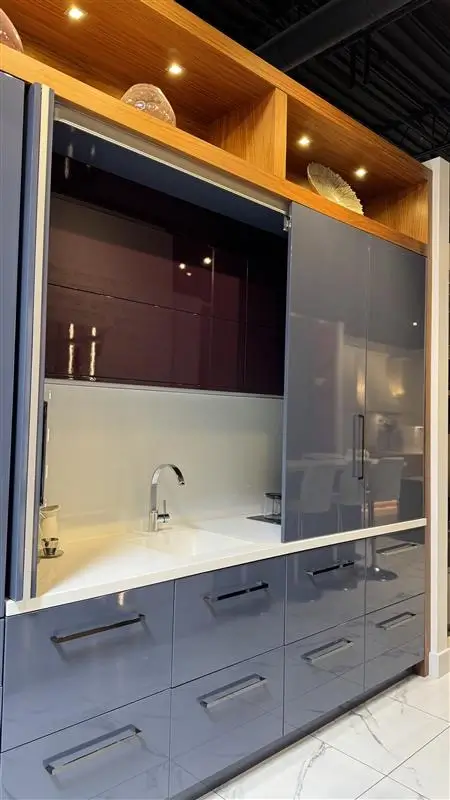
There’s a moment in every well-designed room when something quietly extraordinary happens. Where a door slides open, folds into itself, and vanishes into the cabinetry. The room breathes. The space transforms. What was once a concealed bar becomes a conversation piece; what was a closed entertainment wall becomes a living room’s focal point.
That moment is what a great pocket door delivers. And if you’ve been scrolling through Instagram or Pinterest lately, you have almost certainly seen the satisfying reveal of a hidden kitchen, a coffee bar unfolding from a seamless wall of custom cabinetry, a bedroom storage unit that closes like a secret. Pocket doors are having a cultural moment. As with any trend, the difference between a feature that elevates your home and one that simply follows the crowd comes down to one question: do you actually need it?
At Lucvaa, we think about that question every single time a client asks about pocket doors. And the answer, when the stars align, is deeply satisfying.
What Is a Pocket Door in Custom Cabinetry?
In the context of custom cabinetry, a pocket door, also called a bi-fold pocket door or a sliding concealed door, is a cabinet door system in which panels fold and retract horizontally into a dedicated compartment, or “pocket,” within the cabinet body. Unlike a traditional hinged door that swings outward into the room, a pocket door disappears to the side when opened, fully exposing the interior and leaving a clear, unobstructed opening.
This is distinct from conventional bi-fold doors, which fold outward into the room on a hinge and still occupy space in front of the opening. A true pocket door system, like the HAWA Concepta III, integrates the retracted door panels invisibly into the cabinet, so the door is genuinely out of view when open.
The Benefits of Pocket Doors in Custom Cabinetry
When they’re designed into the right space, pocket doors deliver a combination of functional and aesthetic benefits that no other door system can match.
Full access to the cabinet interior. Without a door swinging outward or folding in front of the opening, you get unobstructed access to the cabinet’s full width and height. For entertainment units, coffee bars, and appliance garages, this is transformative.
A cleaner, more architectural aesthetic. When closed, a pocket door system creates a seamless, consistent appearance across your cabinetry. No visible hinges, no protruding hardware, no interruption in the visual plane. The result is a wall of cabinetry that reads as a single, composed design statement.
Space efficiency in operation. As the door doesn’t swing into the room, pocket doors are ideal for spaces with limited clearance in front of the cabinet, such as narrow hallways, home offices, or any room where you don’t want to navigate around an open door.
Versatility across rooms. Some of the most compelling applications of pocket doors in custom cabinetry include: a concealed home bar or coffee station in a kitchen or living area; an entertainment unit that closes to a calm, media-free wall; bedroom storage where the full wardrobe can be thrown open without doors encroaching into the walking space; and home office alcoves that can be fully closed at the end of the workday, creating a visual boundary between work and home.
The Drawbacks: What to Know Before You Commit
Pocket doors are not a universal upgrade. They are a significant investment in a custom cabinetry project, and they come with real considerations that Lucvaa’s designers will always walk you through honestly.
They require dedicated space inside the cabinet. A pocket door system needs a recessed channel (i.e., the “pocket”) built into the side of the cabinet body to receive the door panels when they retract. This means a portion of the cabinet’s interior width is permanently committed to housing the mechanism. On a narrow cabinet, this trade-off may not be worth it.
They add meaningful cost to a project. The hardware alone is a premium upgrade item. Combined with the additional cabinetry required to accommodate the pocket, this feature needs to earn its place in your budget.
They require precision in construction and installation. A pocket door is only as smooth and long-lasting as the cabinetry it lives in. Misaligned panels, imprecise pocket tolerances, or lower-grade hardware will undermine the entire system. This is why the expertise of your cabinetry manufacturer matters even more, and Lucvaa Kitchens has our clients covered for expertise and ingenuity.
Social media doesn’t tell the whole story. TikTok and Pinterest have made pocket doors aspirational in a way that occasionally outpaces their practicality. A pocket door on a shallow spice cabinet, or a bi-fold system on a linen closet that’s accessed once a week, may add cost and complexity without meaningfully improving your life. At Lucvaa, our designers will always assess pocket doors through three lenses: your needs, your budget, and your aesthetic. If a standard door serves you just as well, we’ll say so.
Why HAWA Concepta III Is a System We Trust
There are many pocket door hardware systems on the market, and Lucvaa has experience across the full range. The HAWA Concepta III, offered in single-door and bi-fold options, stands out due to its unique blend of mechanical accuracy, versatile installation, and authentic design thoughtfulness.
The HAWA Concepta III covers an impressive range of applications: single-door systems for smaller openings and bi-fold configurations for wide spans, and can combine both system types for three- and four-door solutions on large cabinet fronts. Constructions up to 3,000 mm (approx. 118”) wide and 2,700 mm (approx. 106”) high are supported, along with half-height options for lower appliance garages or bar cabinets.
The hardware features soft-close damping and an open-and-close assist mechanism that make single-hand operation feel intuitive and effortless. In a push-to-open configuration that requires no handle, the result is a completely uninterrupted façade across your cabinetry, with not a pull or a grip in sight. For those who prefer handles, the pull version accommodates surface-mounted hardware with equal elegance.
The system’s black anodized aluminum profiles, concealed within the cabinet, contribute to that uniform flush-front aesthetic that defines the best custom cabinetry work.
A pocket door is considered an investment in hardware, in cabinetry construction, and in the thoughtfulness of your overall design. When it’s the right choice for your space, it’s one of the most rewarding details a custom cabinet can deliver. At Lucvaa, we’ll help you decide when it earns its place and when it doesn’t.
If you’re exploring custom cabinetry for your kitchen, closets, or any room in your Toronto-area home, we’d love to talk through your project.